Mrs. Beverly Hansen, a school teacher in Chowchilla, observed three men arriving in a white van and loitering near Dairyland Elementary School. When 26 children and their bus driver disappeared on July 15, 1976, she went to the police and gave an unusually vivid and highly detailed description of them, down to even a chipped front tooth on one and a facial mole on another.
One man was 5 foot 6 inches, thin build, about 45 years old, sideburns, a one-inch scar on his right cheek, and a slanted chipped front tooth. He wore a white hat, heavy dark-rimmed glasses, a blue checked shirt, blue jeans (or brown pants?), and blue tennis shoes. Additional details come from a San Francisco Chronicle interview of a ten-year-old boy named Jeffrey Brown:
“He put on white gloves and drove the bus. They all wore white gloves. . . . He had a straw hat on and black thick-framed glasses. He had a round chin and looked kind of skinny, scrawny. He had black hair. This man’s glasses were worn on the outside of the mask.” Note: Hair color is omitted from Mrs. Hansen’s description, whereas Jeffrey does not mention the age or height. A man with “jet black hair” was described in a police alert bulletin as 35 years old and 6 feet tall. The extreme differences in height and age suggest the existence of two men wearing dark, heavy-rimmed glasses. Eyeglasses might have been part of a disguise to confuse witnesses and police.
Another man was 5 foot 7 (or 6 foot?), very thin build, 23 to 27 years old, blue eyes, moustache and goatee, a mole on the right side of his chin, collar-length brown hair, light complexion. He wore a white T-shirt, blue (or red?) corduroy pants, cowboy boots, and a silver watch with an expansion band. On his right wrist was a blue and green tattoo with a circle. The name “Jerry” was tattooed on his left arm. Note: At least one child on the bus recognized him as “Jerry McCone,” even though his face was hidden behind a nylon mask. Discrepancies regarding his age, height, and the color of his pants are probably due to the same man being seen by different witnesses on different days.
The team commander was somewhere between 6 foot and 6 foot 2 inches. He was about 50 years old, medium to heavy build, gray hair. He wore a tan shirt, light tan corduroy pants, cowboy boots, and a light brown belt with horse heads on the buckle. Additional details come from the aforementioned Jeffrey Brown.
He was “tall, kind of blocky. He was broad-shouldered, eyes far apart and baggy. The guy looked like he was real solid, and he had yellow pimples on his face. His chin was kind of square. He had light brown hair. He had kind of a pug nose that’s wide – sort of flattened out as though broken. He had a short gun. It looked like a sawed-off shotgun.” Note: The color of the pimples and the color of his hair indicate that Jeffrey saw him on an earlier day when he was not wearing a mask. The second time he saw him was on the bus when he was wearing a mask and carrying a shotgun. The best explanation for the confusion is that the San Francisco Chronicle conflated Jeffrey’s first and second observations into one single description.
The three kidnappers bore no resemblance to the ones eventually arrested: Fred Newhall Woods was 24 years old and 6 feet tall; James Schoenfeld was likewise 24 years old and 6 feet tall; and his brother Richard Schoenfeld was 22 years old and 5 feet 11.
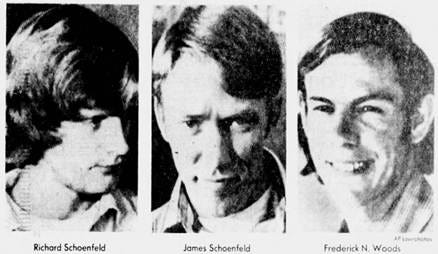
They had neither tattoos nor facial hair. Disparate variations in height prompted Tom Houchins, the Alameda County Sheriff, to say: “When you are four feet, everyone looks bigger.” A more intelligent remark came from an official who avoided repercussions by not giving his name. He said, “It is highly unlikely that those kids and the bus driver would misjudge men in their early to mid-twenties for men 25 to 30 years older.”
Two years later, on July 31, 1978, a UPI article featured the faces of five unidentified men who were allegedly involved in the assassinations of President John F. Kennedy and Dr. Martin Luther King, Jr. One of those faces was recognized by someone in Chowchilla.
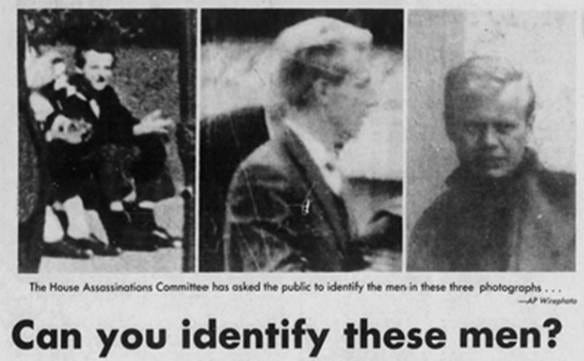
Washington (UPI) – The House Assassinations Committee Sunday asked millions of Americans for help in identifying three photographs and two composite drawings of men who might have some connection with the murders of President John F. Kennedy and civil rights leader Dr. Martin Luther King Jr. The committee said it was releasing the photographs and sketches “in the hope that citizen recognition of them might shed additional light on the assassinations of Kennedy and King.”
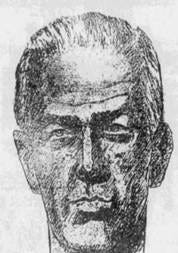
A sketch, captioned “Ralph,” shows a middle-aged, dark-haired, square-jawed man with high cheekbones “who allegedly was in Atlanta in 1967 or 1968.”
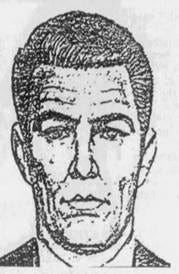
The other composite drawing shows a man with close-cropped hair. The committee said this man “reportedly represented himself as a member of the U.S. intelligence community in the 1960s and on occasion used the name Maurice Bishop.”
The three photographs released by the committee Sunday included a blurred image of a dark-haired man, possibly with moustache, sitting on a curb with a group whose faces do not show. The committee caption said only that the picture was taken in Dealey Plaza “moments after President Kennedy was shot.”
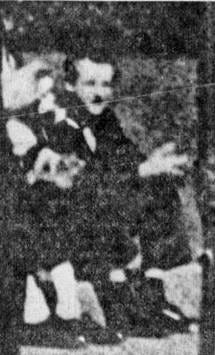
The man sitting on the curb was moments earlier standing up and brandishing an open umbrella at the president as he was being shot in his limousine. The mysterious “Umbrella Man” has stirred much debate, with some suggesting that he was sending a go-ahead signal to the gunmen, while others say that the umbrella was concealing a poison dart gun. These theories went by the wayside when a harmless-looking, Dallas warehouse manager named Louis Witt, age 53, emerged from obscurity and publicly declared that he was the “Umbrella Man.” He went to Washington DC and testified before the HSCA on September 26, 1978. He said his umbrella was a symbolic form of protest against JFK’s father’s support of British Prime Minister Neville Chamberlain’s appeasement policies with regard to Hitler and Nazi Germany. Chamberlain often carried a black umbrella. Congressional members hearing Witt’s testimony could hardly contain their amusement at his barely relevant, pedantic references to European diplomacy in the 1930s to explain why he was heckling the president that day.
The article continues:
The other two photographs, according to the commission, are “of two men who may have been in Mexico City in the fall of 1963 when Lee Harvey Oswald was there.”
One photograph, badly scratched and blurred, is a side shot of a light or gray-haired, aquiline-nosed man who could be in his late 40s or 50s. He wears a light suit, shirt, and tie. The face of a man leaning beside his left side is obscured.
The other photograph shows a handsome, apparently blonde-haired man in his 20s or early 30s. He appears to be wearing a jacket over a dark turtleneck sweater or pullover.”
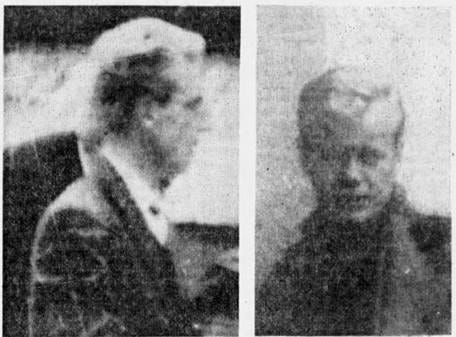
A woman living in Chowchilla saw the above article in the Fresno Bee and immediately recognized someone she knew. She took the newspaper to the sheriff’s office and showed it to Sgt. Dale Fore. She said that a picture of her boyfriend Claude Barnes Capehart aka “Buster” was in the article. Fore looked at the indicated face and agreed that he “was a dead ringer for Capehart.”
The above account appeared in an article written by Pablo Lopez for the Fresno Bee, November 21, 1994 entitled “Ex-judge pursues CIA tie to JFK killer.” Excerpts from the article follow:
Thirty-one years after the assassination of President John F. Kennedy, a Chowchilla judge is butting heads with the federal government in an effort to prove that the CIA was involved in the killing. Judge David D. Minier has waged a two-and-a-half-year fight against the Central Intelligence Agency, which has denied Minier’s Freedom of Information Act request whether a former Chowchilla resident was a CIA operative and possibly connected to the Kennedy killing.
In court papers, Minier said a former Chowchilla resident, Claude Barnes Capehart, who said he was a CIA hit man, talked of being with Oswald when Kennedy was gunned down in Dallas, Nov. 22, 1963. Capehart, who died in 1989, also had told others that Oswald didn’t kill Kennedy.
Minier filed the lawsuit on July 20 as a “private citizen engaging in historical research.” His pleadings rely heavily on information gathered by Dale Fore, a former colleague of Minier’s. Minier, who was Madera County’s district attorney for several years, worked with Fore, former chief of detectives for the Madera County Sheriff’s Department.
Fore said he first met Capehart in 1976, when Fore was a deputy with the sheriff’s office. Fore, who has since retired, said he learned more about Capehart from Capehart’s girlfriend, whom he refused to identify. Fore believes the girlfriend could be in danger if her name is released.
Seventeen years later in an October 3, 2021 article written for the Fresno Bee, David Minier revealed the name of the girlfriend: Faye Weaver. According to an obituary, she was born on November 6, 1929 and died in a Chowchilla convalescent hospital on February 25, 2003 at the age of 73. She had been a resident of Chowchilla for 70 years.
Curiously, neither Lopez nor Minier mention Minier’s and Fore’s connection to the Chowchilla kidnapping case. Minier was the prosecuting attorney, while Sgt. Fore, along with Sgt. Glenn Seymour, took the lead in bringing Fred Woods and the Schoenfeld brothers to justice.
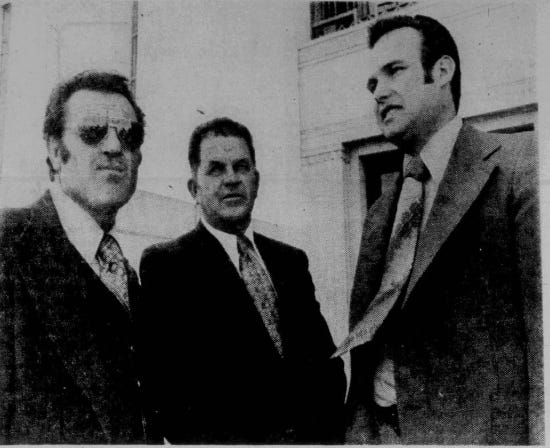
Left to right: Dale Fore, Frank Ray (bus driver), and Glenn Seymour on Alameda County steps
According to Lopez and Minier, Capehart’s face is among the three photographs in the 1978 article. This removes from consideration the two composite sketches. The next question is which photograph. Both authors neglect to say, so a process of elimination is needed. The photograph of the man sitting on the street curb can be set aside, because he has already been identified as Louis Witt. Therefore, Capehart must either be the aquiline-nose man or the blonde-haired man. Fortunately, no guesswork is needed. Examination of pictures of Capehart posted on a Find-a-grave website leaves no doubt that he is the blonde-haired man.
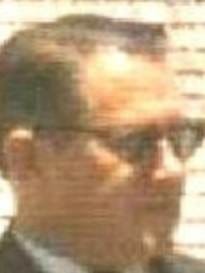
Claude Barnes Capehart
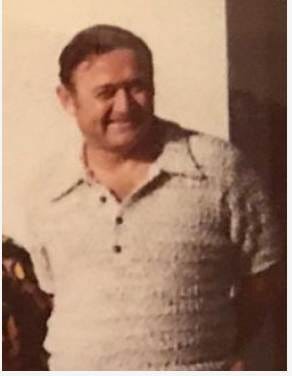
Capehart circa 1975
Note: No information regarding the identity of the man with the aquiline nose has ever come to light.
Capehart moved to Chowchilla in 1976, sometime prior to the school bus kidnapping. He was 51 years old, 6 feet 1 inch, 220 pounds. These statistics line up almost perfectly with the description of the leader of the abduction team: 50 years old, between 6 foot and 6 foot 2, medium to heavy build. The possibility therefore exists that both the team leader and Capehart were the same man.
Dale Fore first met Capehart in 1976. When and under what circumstances his meeting with Capehart occurred, neither Lopez nor Minier had anything to say. The possibility exists that the meeting occurred during the course of Fore’s investigation of the Chowchilla kidnapping case.
According to Fore, Capehart came to Chowchilla to “start a well-drilling business,” that he “led a quiet life,” and that he always carried “a bundle of cash.” When some of his business equipment was stolen from his place of business, Fore stepped in to investigate. During the course of his investigation, he obtained access to a listing of Capehart’s long distance calls and they were to persons all over the country. When four months later, in December 1978, he was asked by Surrell Brady, a staffer working for the HSCA, who these people were, Fore said he could not remember their names.
Fore had much to say about his dealings with Capehart sometime early in 1977. Capehart came into the sheriff’s substation in Chowchilla and asked for police protection. Two men in dark suits from New York or Cleveland were looking for him and wanted to kill him. He was in trouble because of an assignment he did for the CIA in New York. He admitted that he worked for the CIA on other occasions but couldn’t discuss what he did.
Whoever these men in dark suits were, Fore was confident he could find them. Chowchilla was a dusty, Central Valley farming community with a population of 6,000 people, and two well-dressed strangers from back East could hardly go around town completely unnoticed. Yet no matter where he looked, Fore could find no trace of them. This led him to doubt Capehart’s story, and he wondered if he was a fake. He soon realized he was genuine, however, after talking with his girlfriend. She had sought out Fore, because she feared the threats made against her by Capehart after the visit by the men in dark suits.
Fast forward now to July 31, 1978. After Fore saw the article with Capehart’s picture in it, he contacted a retired FBI agent. His friend confirmed that he had indeed worked for the CIA as a crane operator on industrialist Howard Hughes’ Glomar Explorer, the deep-sea research vessel that under CIA sponsorship raised a Soviet submarine that mysteriously sank in the Pacific Ocean in 1968.
Fore was ready to begin an investigation, but Capehart was not in town. His whereabouts are revealed in a brief notice in the July 31, 1978 edition of the Lassen Advocate:
The Lassen County Sheriff’s Department is investigating the burglary of a generator and tools valued in excess of $1,000 which occurred Friday, July 28, near Ravendale.
Buster Capehart of Chowchilla reported the generator and tools were taken from his parked trailer Friday at 3 p.m.
Ravendale is located in Northern California, about 380 miles north of Chowchilla.
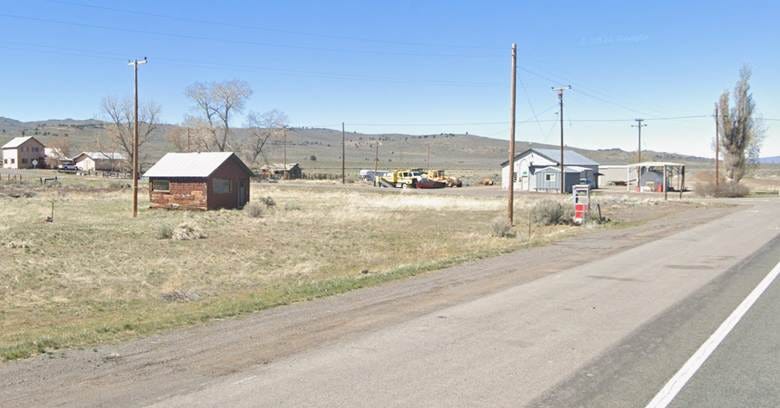
Downtown Ravendale
If Capehart had any forewarning that his picture would soon appear in news media all over the country, he could not have picked a more remote place to hide in. Ravendale is a small, quiet, unincorporated community with about 45 to 80 residents. It is surrounded by wide-open high desert terrain and rural ranches. The town served as a station stop on the Nevada-California-Oregon rail line. Regular stops were also made by a Greyhound bus running a route along Highway 395. Nearby was a small, unattended county airstrip. If trouble ever came his way, he could easily make a quick getaway by car, bus, train, or plane. Dale Fore told an HSCA staffer that Capehart fled to Las Vegas three days after the publication of the article. Before reaching his destination, he made a brief stop in Chowchilla to make threats against Weaver if she had any thought about talking to the authorities.
Nevertheless, she did talk to Fore. During tape-recorded interviews, Weaver said her relationship with Capehart broke off some time ago. Fore asked her if she had a picture of Capehart. She said he was “absolutely paranoid” about having his picture taken, so much so that he did not have a picture on his California driver’s license as required by law. She did however see Capehart’s photo in his passports but under assumed names. Fore subsequently contacted the Department of Motor Vehicles and asked why his license lacked a picture. No one at the DMV could give him an answer.
Capehart told Weaver that he had worked as a hit man for the CIA on numerous occasions. He had been “in” on the plot to kill Kennedy and that he was in the Texas School Book Depository with Lee Harvey Oswald. The accused assassin was involved in the plot, he said, but he did not fire any shots. (Assassination researcher Mae Brussell believes that Oswald’s original role was to serve as a decoy. Sometime after he was arrested and brought to police headquarters, he was surprised to discover that he was going to be the patsy.)
In September 1973, Capehart was in Chile and was among the CIA operatives who successfully overthrew the government of Salvador Allende.
He knew something about the killing of labor leader Jimmy Hoffa. His body was buried in an animal shelter located in a large junkyard in Queens, N.Y.
Capehart had a high-power rifle with scope, a handgun with silencer, automatic firearms, a cyanide pistol, and numerous other firearms. He carried a pistol both on his person and in his car. He had a collection of items he had taken from the Glomar Explorer and from the Soviet nuclear submarine K-129. Among his private papers were sheets of paper filled with what appeared to be cyphers. While she was still living with him, Weaver made copies of the cyphers on separate sheets of paper and kept them. During the interview sessions with Fore, she handed him the copies.
Capehart told both Weaver and Fore that he retired from the CIA in 1975. Actually, the year he retired was 1978. Former FBI agent, Ted Gunderson told David Minier that an informant, Bob Brownell, knew Capehart when both were employed by the CIA. Brownell said Capehart had retired from the CIA around 1978 “with a lot of money.” He used his money to buy oil well drilling companies. Therefore, at the time of the Chowchilla kidnapping, Capehart was still on the CIA payroll.
CIA documents released in 1997 and various newspaper notices show that Capehart was born on October 15, 1924 in Okemah, Oklahoma. He was number nine of thirteen children born to Henry and Laura Capehart. When he was a teenager, he went to California to be near his brother Herman who owned a cafe in a small town called Tranquility (47 miles south of Chowchilla). After graduating from Tranquility High School, he joined the Army in 1943 and served for three years, attaining the rank of sergeant.
After the war, he went back to California, where he married Roberta Battey in Riverside in November 1951. From 1961 to 1972, he resided in Las Vegas where he worked intermittently as a drilling operator, motorman, derrickman, and heavy forklift operator for Reynolds Electrical and Engineering, a Las Vegas company that managed the Nevada Test Site, where nuclear devices were tested. A CIA document dated November 20, 1963, two days before the JFK assassination, shows that he was living in a modest home at 4815 Carmen Blvd. In Las Vegas. The same document describes him as 6 feet 1 inch, 220 pounds, brown hair, blue eyes.
In September 1972 he and his wife moved to New Jersey, where he worked in nearby New York City on the North River Pollution Control Project as supervisor on a barge equipped with drilling equipment. He left this job in June 1973. In October 1973 he began working for Global Marine, which designed, built, and operated the Glomar Explorer. His employment overlapped the covert raising of Soviet sub K-129 during the summer of 1974. A document released by the CIA shows that he departed from Global Marine on July 9, 1975. Beyond that date, his file has been totally scrubbed. Among important notices removed include his whereabouts on July 30, 1975 when Jimmy Hoffa disappeared and what he was doing on July 15, 1976 when the abduction of the school bus occurred.
Also removed from his file were all his activities as a CIA hit man, including Dallas on November 22, 1963 and Santiago, Chile on September 11, 1973.
His marriage to Roberta apparently broke up prior to the Chowchilla kidnapping. Notices in the Nevada State Journal and the Reno Gazette-Journal, June 25, 1976, show that Roberta Battey Capehart, age 53, and Cecil Newell, age 63, living in Dos Palos got a marriage license. Dos Palos is not far from Chowchilla, about 25 miles. Roberta’s second marriage was short-lived, however, and she returned to her first husband two years later. A newspaper notice shows that on May 24, 1978, “Claude B. Capehart, 53, of Chowchilla and Roberta B. Capehart, 55, of Las Vegas” got a marriage license. Apparently, he stopped seeing Faye Weaver at this time. Speculation suggests that the break-up and later remarriage to Roberta was an elaborate ploy to get her out of the way in case something went wrong with the kidnap operation.
In December 1978, Fore was in Washington DC for a training course with the FBI. Since the office of the HSCA was nearby, he met with Dick Billings, the editorial chief for the final report. Also at the meeting were some officials from the FBI. Fore loaned them the newspaper article with the alleged photo of Capehart, a tape recording of his interview with Faye Weaver, interview notes, and the cypher sheets. When they met for a second time, several weeks later, Billings and the FBI men returned some of Fore’s evidence, but they refused to give him the cypher sheets, claiming they were “classified government codes.” Afterwards, Fore learned that someone broke into the HSCA office and stole the cypher sheets.
An article from the San Francisco Chronicle July 5, 1996 says that in 1988 district attorney investigator Dan Poole traced Capehart to his residence in Pahrump, Nevada. Poole and Minier planned to confront Capehart at his home in an attempt to find out his true relationship with the CIA. They arranged for a Nye County sheriff’s sergeant to accompany them and agreed upon a date in two weeks. On January 3, 1989, Capehart was standing in his front yard when he dropped dead from an apparent heart attack – only a few hours before the arrival of Poole and Minier! Since heart attacks can be induced by cyanide when sprayed into the face, it is possible that Capehart did not die from a natural cause. It is probably true that he who lives by the cyanide gun dies by the cyanide gun.
The San Francisco Chronicle article closes with the following comment:
“After he died,” Minier said, “things kind of dried up in terms of information, and so there was nothing else to do but ask the CIA about it.”
It would not be until 1997 that Minier’s tireless efforts would eventually force the CIA to release Capehart’s file, albeit with substantial omissions.
There is no denying that a high-ranking CIA operative who played a key role in the Kennedy assassination was close at hand when the politically charged disappearance of 26 children and their bus driver occurred. Circumstantial evidence identifies Capehart as the one who led the team that seized the bus and abducted its occupants. The kidnapping was an operation planned down to the smallest detail. It had every chance of success, and none of the victims was expected to live to tell the tale. It must have come as a shock to the conspirators when the captives emerged from their subterranean tomb. The cover up artists went into panic mode and adopted impromptu measures to keep the lid on the truth. The lid however did tumble off two years later with the publication of the HSCA article on July 31, 1978.
Political calamities such as the slayings of President John F. Kennedy, Senator Robert F. Kennedy, and Dr. Martin Luther King, Jr., as well as the Chowchilla kidnapping all share the following key factors that together mark them as CIA-directed conspiracies.
- selection of a patsy, or patsies
- rapid appearance of a pre-arranged cover story
- control of news media to showcase evidence and witnesses that support the official story
- control of law enforcement agencies on the local, state, and national level
- control of the court system, including prosecutors, defense attorneys, and judges
- destruction or alteration of evidence that does not support the official narrative
- suppression of witnesses and whistleblowers who threaten to blow the cover story
In the case of the Chowchilla kidnapping, the patsies originally planned were leftist radicals. The timing of the kidnapping would taint by association the Democratic National Convention in New York City and its selected candidate for president Jimmy Carter, a left-leaning governor of Georgia who was anti-CIA and an advocate of civil rights for minorities. With the escape of the captives, a new cover story had to be concocted about three rich kids who meant no harm but were just having a little fun. This flimsy cover story was under constant threat of being blown apart by the continued existence of twenty-seven survivors who might someday reveal what they really saw during their captivity. Large payments of cash accompanied by the direst of warnings were an obvious solution. For the few who could not keep quiet, they would perish under mysterious circumstances. That the cover story is still holding together even after the passing of fifty years can only be achieved by an institution that has the motive, the means, and the opportunity to keep it going. Even to this day, CIA-controlled media such as the New York Times and Time magazine still say that Lee Harvey Oswald was the lone assassin of President Kennedy (in spite of the most recent Gallup Poll that shows only 29 percent of Americans believe the Warren Report). Likewise, the same media promote the false story that the only perpetrators of the Chowchilla kidnapping were Fred Woods and the Schoenfeld brothers.


